Motion sensors play a crucial role in modern commercial lighting projects. They help reduce energy consumption, improve user convenience, and support sustainability goals. From offices to warehouses, motion sensor–controlled lighting has become a standard solution across many commercial environments.
In this article, we explore the most common applications of motion sensors in commercial lighting projects and explain why they are essential in each scenario.

1. Office Buildings
Motion sensors are widely used in office environments to automatically control lighting based on occupancy.
Typical applications include:
- Individual offices
- Open-plan workspaces
- Meeting and conference rooms
- Copy rooms and storage areas
Key benefits:
- Lights turn off automatically when rooms are unoccupied
- Reduced energy waste during off-hours
- Improved compliance with green building standards (LEED, BREEAM)
PIR sensors are commonly used in offices, while dual-technology sensors are preferred for meeting rooms where occupants may remain seated for long periods.
2. Commercial Corridors & Stairwells
Corridors and staircases are high-traffic areas but are often unoccupied for long periods.
Why motion sensors are ideal here:
- Automatic on/off lighting improves safety
- Significant energy savings compared to continuous lighting
- Reduced maintenance and longer lamp life
Microwave motion sensors are frequently chosen for corridors due to their wide detection coverage and ability to detect movement through partitions.

3. Parking Garages & Underground Car Parks
Parking facilities are one of the most common commercial applications for motion sensor lighting.
Common sensor-controlled zones:
- Driving lanes
- Parking bays
- Pedestrian walkways
- Entry and exit ramps
Advantages:
- Lights brighten only when vehicles or pedestrians are detected
- Improved safety and visibility
- Substantial energy savings, especially in 24/7 facilities
Microwave and dual-technology sensors are preferred due to their long detection range and reliability in low-temperature or low-light environments.
4. Warehouses & Logistics Centers
Warehouses often have high ceilings and intermittent human activity, making them ideal candidates for motion sensor lighting.
Typical applications:
- Storage aisles
- Loading docks
- Picking and packing zones
Why motion sensors are critical:
- Prevent lights from staying on in unused aisles
- Support high-bay LED fixtures
- Reduce operational energy costs
High-sensitivity microwave sensors are commonly used because they can detect movement at long distances and from forklifts.

5. Retail Stores & Shopping Centers
In retail environments, motion sensors help balance energy efficiency with customer experience.
Applications include:
- Stock rooms
- Changing rooms
- Back-of-house areas
- Mall corridors and restrooms
Benefits:
- Enhanced comfort for customers
- Reduced energy usage during low-traffic hours
- Smart lighting control integrated with daylight sensors
Dual-technology sensors are often used to avoid false triggering caused by HVAC systems or background movement.
6. Hotels & Hospitality Facilities
Hotels rely on motion sensor lighting to improve guest comfort while controlling operational costs.
Common installations:
- Guest room entrances
- Hotel corridors
- Restrooms and utility areas
- Conference and banquet halls
Motion sensors provide seamless automation without compromising the guest experience, especially when combined with time-delay and daylight control features.

7. Educational & Healthcare Buildings
Schools, universities, and hospitals require reliable and energy-efficient lighting solutions.
Typical use cases:
- Classrooms
- Lecture halls
- Restrooms
- Storage rooms and corridors
Why sensors matter:
- Reduce energy waste in unused spaces
- Support safety and compliance requirements
- Minimize manual interaction in healthcare environments
PIR sensors are widely used in classrooms, while dual-technology sensors are preferred in critical areas where accuracy is essential.
Conclusion
Motion sensors have become an indispensable component of commercial lighting projects. Whether in offices, warehouses, parking garages, or hotels, they help reduce energy costs, improve safety, and support sustainable building strategies.
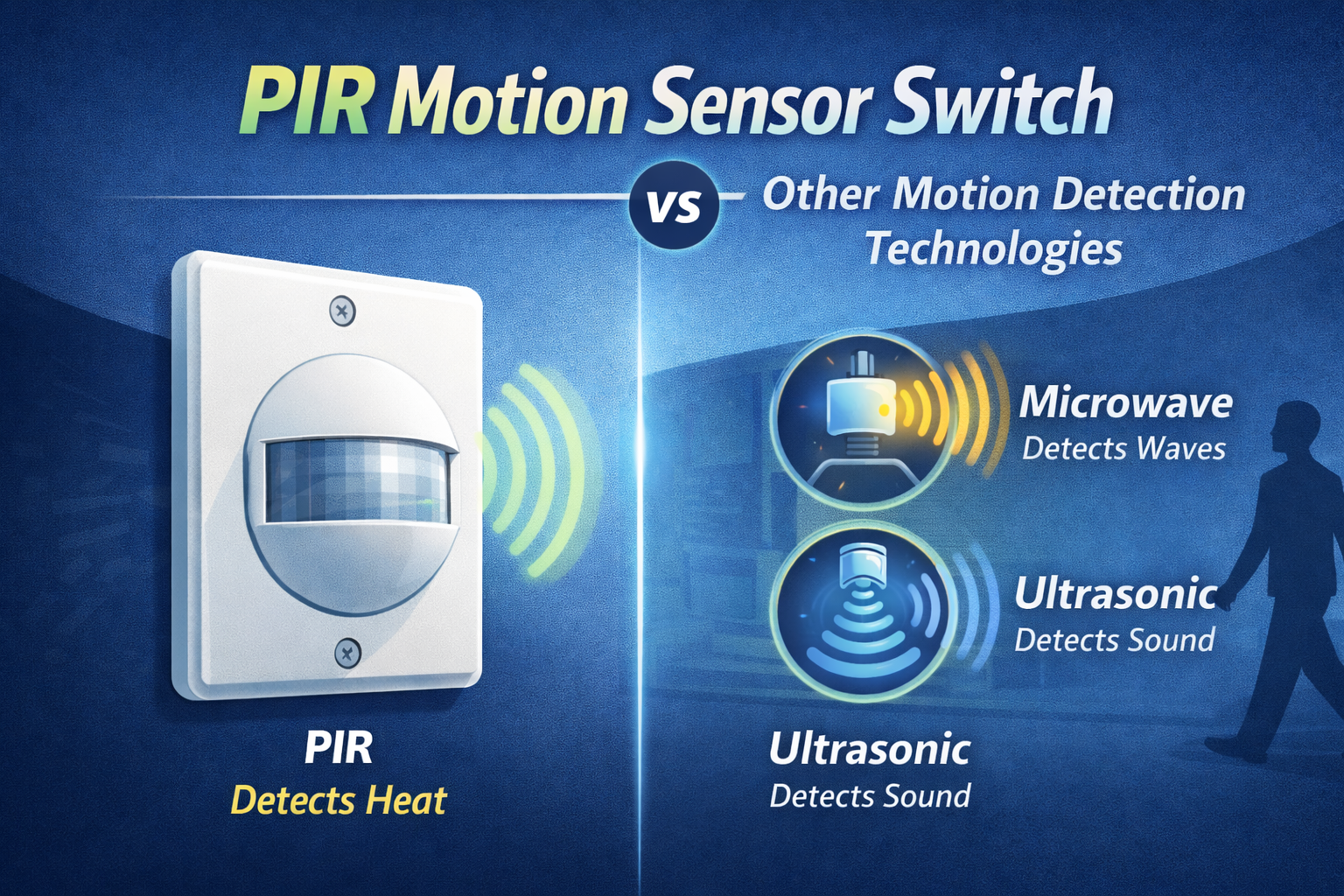
Choosing the right type of motion sensor—PIR, microwave, or dual technology—depends on the specific application, environment, and project requirements.
🖼️ Image Placeholder