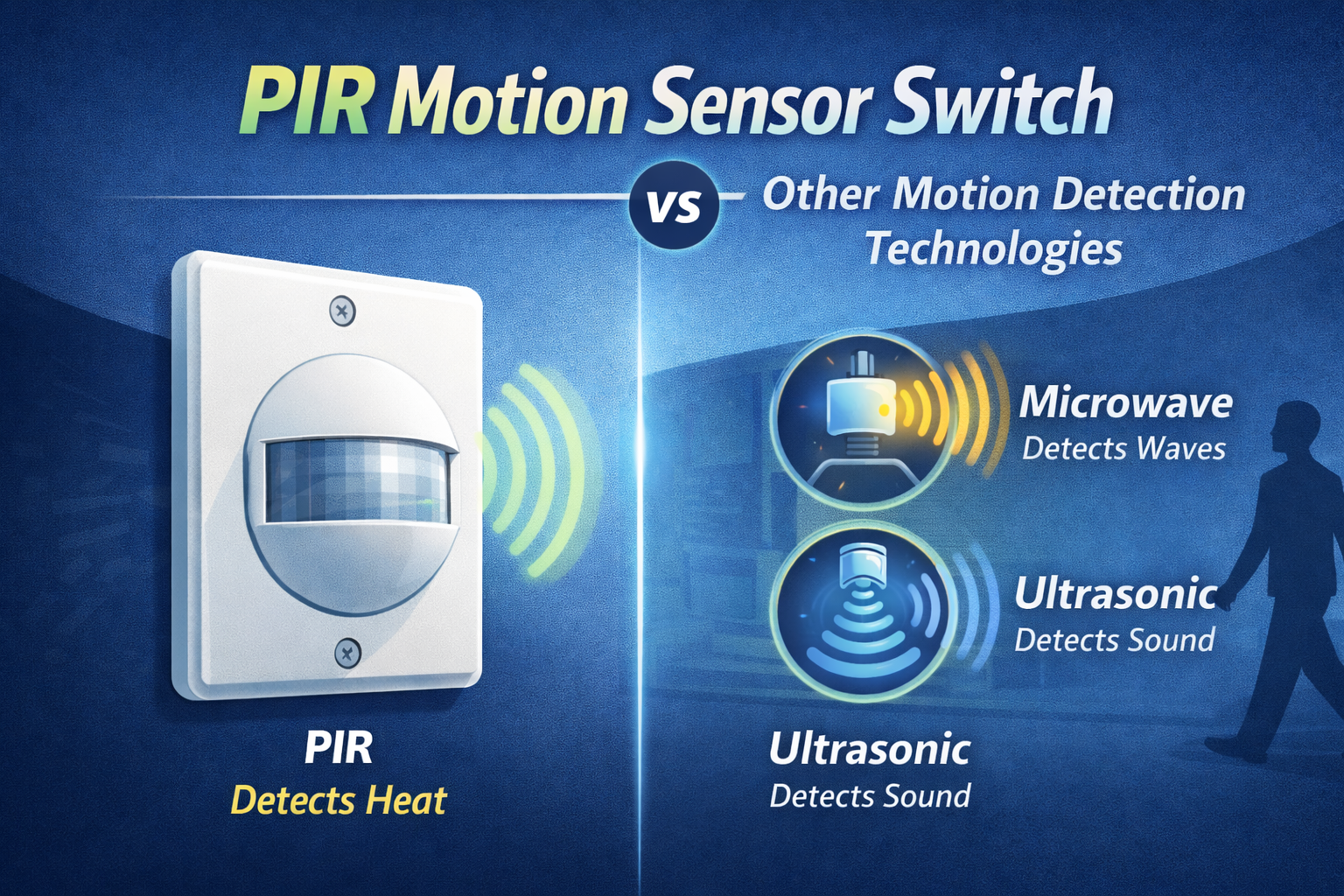
A PIR motion sensor switch works by detecting changes in infrared radiation emitted by objects, especially the human body, within its sensing area.
It is one of the most widely used technologies in automatic lighting systems due to its reliability, low power consumption, and cost efficiency.
The Basic Principle of a PIR Motion Sensor Switch
All objects with a temperature above absolute zero emit infrared radiation. The human body, in particular, emits a consistent level of infrared energy.
A PIR motion sensor switch detects motion by sensing changes in this infrared radiation when a person or object moves across its detection field.
Unlike active sensors, a PIR motion sensor switch does not emit any signals. It passively receives infrared energy from the environment.
Key Components of a PIR Motion Sensor Switch
A typical PIR motion sensor switch consists of the following components:
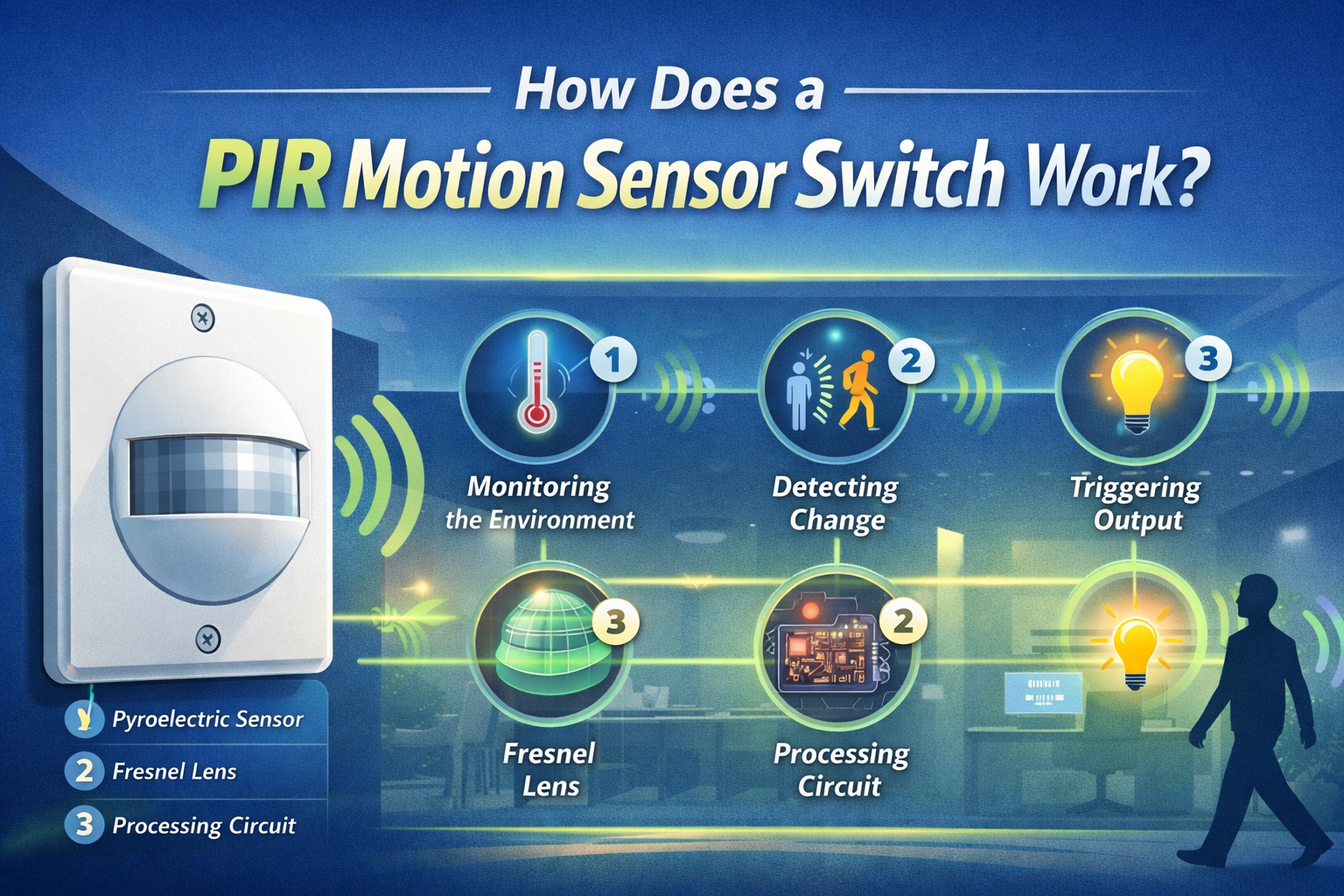
1. Pyroelectric Sensor
This is the core element that detects infrared radiation. It generates an electrical signal when it senses changes in heat levels.
2. Fresnel Lens
The lens helps focus infrared signals from different zones into the sensor, increasing detection sensitivity and range.
3. Signal Processing Circuit
This circuit analyzes the signal from the sensor and determines whether motion has occurred.
4. Control Module (Switch Output)
Once motion is confirmed, the PIR motion sensor switch triggers the connected device, such as turning a light ON or OFF.
These components are integrated into products developed by professional PIR motion sensor switch manufacturers.
Step-by-Step Working Process
The operation of a PIR motion sensor switch can be understood in three steps:
Step 1: Monitoring the Environment
The sensor continuously monitors infrared radiation in its detection area.
Step 2: Detecting Change
When a person enters or moves within the detection zone, the infrared levels change rapidly.
Step 3: Triggering the Output
The system processes this change and activates the connected load, such as lighting.
After a preset delay time, the PIR motion sensor switch will automatically turn the device OFF if no further motion is detected.
Detection Zones and Motion Sensitivity
A PIR motion sensor switch does not detect motion uniformly across all directions. Instead, it divides the detection area into multiple zones using the Fresnel lens.
When a person moves across these zones, the sensor detects alternating infrared signals, which improves motion detection accuracy.
This is why movement across the sensor (side-to-side) is often detected more effectively than movement directly toward it.
Factors That Affect PIR Motion Sensor Switch Performance
Several factors can influence how well a PIR motion sensor switch works:
- Ambient temperature (very high temperatures may reduce sensitivity)
- Installation height and angle
- Detection range settings
- Obstructions such as walls or glass
- Movement speed of the object
Understanding these factors is important when selecting products from a reliable motion sensor switch supplier.
Practical Example of PIR Motion Sensor Switch Operation
For example, in a hallway:
- When a person walks into the area, the PIR motion sensor switch detects a change in infrared radiation
- The light turns ON automatically
- After the person leaves and no movement is detected, the light turns OFF after a delay
This process improves both convenience and energy efficiency.
Conclusion
A PIR motion sensor switch works by detecting changes in infrared radiation and converting those changes into electrical signals that control connected devices.
Its simple yet effective working principle makes it a core technology in modern smart lighting systems.
For businesses and project buyers, understanding how a PIR motion sensor switch works can help in choosing products from a qualified PIR motion sensor switch manufacturer.
If you are just looking for a reliable pir motion sensor switch manufacturer based on China,welcome to contact us directly.