Motion sensors play a crucial role in modern lighting systems by improving energy efficiency, safety, and user convenience. Among the most widely used technologies are PIR (Passive Infrared) sensors and Microwave motion sensors.
But which one is better for lighting applications?
This article compares PIR and microwave sensors in terms of working principle, performance, installation, and ideal use cases—helping you choose the right solution for your lighting project.
What Is a PIR Motion Sensor?
PIR (Passive Infrared) sensors detect movement by sensing changes in infrared radiation emitted by warm objects such as humans or animals.
How PIR Sensors Work
- Detect heat differences between a moving object and the background
- Trigger lighting when a warm body moves across detection zones
- Do not emit any signal (passive detection)

Advantages of PIR Sensors
- Low power consumption
- Cost-effective
- Stable performance in indoor environments
- Less sensitive to minor movements or interference
Limitations of PIR Sensors
- Requires line of sight
- Performance affected by ambient temperature
- Limited detection range
- Less sensitive to slow or small movements
What Is a Microwave Motion Sensor?
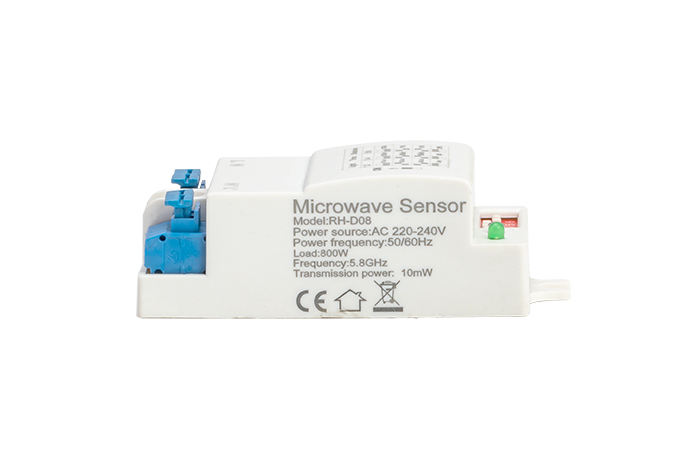
Microwave motion sensors actively emit low-power microwave signals and detect changes in reflected waves caused by movement.
How Microwave Sensors Work
- Continuously transmit microwave signals
- Detect motion via Doppler effect
- Can detect movement through non-metal materials (plastic, glass, thin walls)

Advantages of Microwave Sensors
- Longer detection range
- Highly sensitive, even to slight movements
- Works through fixtures and non-metal obstacles
- Unaffected by ambient temperature
Limitations of Microwave Sensors
- Higher cost than PIR
- May detect movement beyond intended areas
- Requires careful sensitivity adjustment
PIR vs Microwave Sensors: Side-by-Side Comparison
| Feature | PIR Sensor | Microwave Sensor |
|---|---|---|
| Detection Method | Infrared heat | Microwave signal |
| Sensitivity | Medium | High |
| Detection Range | Short to medium | Medium to long |
| Line of Sight Required | Yes | No |
| Temperature Influence | Yes | No |
| Power Consumption | Very low | Low |
| False Trigger Risk | Low | Medium (if not tuned) |
| Cost | Lower | Higher |
Which Sensor Is Better for Lighting Applications?
The “better” sensor depends entirely on the application scenario.
PIR Sensors Are Better For:
- Residential lighting
- Offices and meeting rooms
- Corridors with predictable movement paths
- Cost-sensitive projects
Microwave Sensors Are Better For:
- Warehouses and industrial facilities
- Parking garages
- Stairwells and long corridors
- Enclosed luminaires
- Smart lighting systems requiring high sensitivity
Can PIR and Microwave Sensors Be Combined?
Yes. Many modern lighting solutions use dual-technology sensors, combining PIR and microwave detection to achieve:
- Higher accuracy
- Reduced false triggers
- Improved reliability in complex environments

Final Thoughts
Both PIR and microwave sensors are proven technologies for lighting control.
- Choose PIR when you need simplicity, low cost, and stable indoor performance
- Choose microwave when sensitivity, coverage, and flexibility are priorities
For professional lighting applications, understanding these differences helps ensure optimal performance, energy savings, and user satisfaction.
Looking for the Right Sensor for Your Lighting Project?
If you need assistance selecting PIR, microwave, or dual-technology sensors for LED lighting, feel free to contact a professional sensor manufacturer or solution provider.